Showing posts with label Juan Uribe. Show all posts

June 25, 2017

Ten affective activities to play and learn with alphabet letters


Every English teacher has given classes in which he or she has taught students the sounds of letters and has given support for them to spell their first and last names. Even though letters appear in the first levels, it is not unusual even for intermediate students to have some trouble spelling. 

In this post I share 10 affective activities for you to expand your activity repertoire beyond singing the ABC song and playing hangman. I call them affective because we always have to play using our affect, either by choosing words we like, creating strategies, or just playing. Make sure you have 3 or 4 alphabet sets for these activities for a small group of students. If you are with a larger group, you will need many more. 

Here I share some creative alphabet activities that will engage your students. 

1. Choosing words you like: here students choose words that they have read or listened in a story and then they write these, spell them and say why they like them. This activity can be done in the following two ways: students can choose the word and write them and other students check and spell or the student who chose the word can spell and other students have to guess and write it with the letters. Make sure that students always share why they have selected that word. If your students are really motivated, you can even invite them to make a song with the words the group has chosen!


2. Letter theater: here you can create a scenario with your students in which they add things that can be seen in a certain place. You can decide with them any place, ranging from a spaceship, the classroom, a kitchen or the beach. Each student adds one piece at a time.

You can have students use a structure such as "I see a/an ... ", "Have you seen there is a/an ... ?" or any other that you are working with. After you finish the setting, you can ask students in pairs to remember what each letter stands for and even to create a story with all these components.

Here you have a beach setting with the following elements starting from the bottom to the top: whale, fish, wave, surfer, sand, child and her mother, seagull, cloud and the sun!

And advanced variation would be to give all students a chosen combination of letters and they come up with a setting.

3. Letter interaction: here students pick a letter and say a thing that starts with that letter. If one student has chosen B and a banana, he or she can pretend to be eating it. Another  student can have a B which is a butterfly that suddenly flies away, and a third one can have a U for an umbrella that he has in case it starts raining.  Once learners have their things you can ask them to exchange the things they have for others, ask them which go together, make a story, or even line up according to some criteria (size, price, etc).

Variation: you can have the first person starting with a letter and a thing and the next has to do something related to that first thing. Let's say the first students has a Flower, then the second has a Bee, than the next one Honey, and another the Sun, etc. It is easier if you allow students to choose the letter instead of having them come up with something with the letter they have been given.

4. Letter story with words that begin with the letter: here students make sentences with each word starting with the letters that are in a certain order.


Students can make the following sentences for the letters in the sequences above: 

In the easy variation students can insert other words to make their sentence: 
An elephant watched a duck climbing on a white goose. 

In the harder variation students can only use words that start with the letters:
Once upon a time many lions ate spinach. 


5. Anagrams: in this classic activity students write a word for every letter of their names. These words can be adjectives that are characteristics of the students, verbs that they like to do, or things they have. As you have probably thought this is a great activity for students to introduce themselves. The words can either cross any letter of a student's name of can start with the letters in a student's name.

Anagrams be done both at the beginning and at the end of courses. In the beginning students do their own names and at the end students do the name of one of their classmates.


6. Scrabble: in a similar way students make a crossword writing words about a certain topic using the letters they have available. You can play it individually or you can have them playing it in groups.

7. Wordsearch: here you can prepare a wordsearch like the one below for students to find words related to a certain topic. The catch here is for you to tell students only the topic, and not the actual hidden words.

See you can find five words in this wordsearch that I have prepared for you. The topic is teaching. Write the words in the comment session below!


8. Guess before I finish spelling it: a fun way to play with the letters is this game that I play with with my students. I start spelling a word and students go finding the letters and writing the words. The challenge is for them to discover the word before I spell it until the end. It's quite fun!

9. Socratic Answers: here students have to answer questions using words that start with the letter that they have chosen. Example for a students that got the letter B:

What's your name? Boris
Where are you from? Bulgaria
What's your favorite food? Bulgarian banitsa - contribution from Mineva Rositsa! Thank you!
What do you do during your free time? Bake cakes
What is your favorite sport? Basketball


10. Domino: in this easy and fun activity students make word chains always using the first and last letters of the words that have been played. As a challenge you can tell students that they have to close the chain finding a word that starts with the first and last letters of the words in the beginning and in the end of the chain. In the picture here that word could be "sum".


And here you get the traditional bonus activities! Gotta make the reader satisfied! 

Bonus 1 - Scrambled letters: here you give the scrambled letters of a word and then students have to guess and write the word. You can give one hint at a time to make the students discover it. You can tell the context where the word is used, if it's a verb, and so on. Then students do the same to each other. 

Bonus 2 -  Bananagram: in this game a group of students has to use all their letters they have to make a crossword like the one in the picture. In order for them to achieve this goal they will need to change their words several times. Getting the actual game is really nice, but you will need many sets to play with a large classroom. The plastic letters will do fine and you can just use the rules of the game. 
Bonus 3: Make a letter doll: I saved the most creative to the end! I always like to present different kinds of material without telling students what we are going to do with them. I remember being with this very creative girl that started making letters characters as soon as I put the letters on the floor. It really pays of wait and see what your students will come up with!                                                                                                                                                                         You can them use the letters here to describe the personality of the character and the things it likes doing. Our character here has white hair, and it is very elegant, it's a violent and likes to fight, but it can be docile sometimes. It has a watch and a medal for playing soccer! 

Wow! What a fun-tastic post!
I hope you have enjoyed reading it as much as I have enjoyed writing it.

Do you have any different activities do you do with letters?
Share them in the comment area below. I will love to hear from you!


Hugs,


Juan


Did you like it? Share it!
Thank you!


October 30, 2015

Interviewing Affective Educators: Jason R Levine


"Love yourself and your expression, you can't go wrong"
KRS-One


This last August I had the great pleasure of meeting Jason R. Levine, also known as Fluency MC, and working with him during one week in the Gallery Day Camp in Italy. During this week I was able to see Jason promoting learning through rap and I discovered that Jason and I are artisteachers in our own ways. I couldn't have let him go without interviewing him first. Here is our chat: 

Juan: I am really happy that we are working together here in Italy as I had heard a lot about you, but only being here makes me able to better understand your work. Have to tell you that I am your fan.


Jason: Likewise, I follow what you are doing as a teacher and as a teacher trainer around the world. It is interesting to see how my work and your work complement each other. It's really exciting. It's a great feeling to be here.


Juan: I will start our interview by asking the classic question: Who is Jason R Levine?  But don't go thinking that this interview will be an easy one!

Jason: It's funny, there are a lot of Jason Levines out there and I put my middle initial  R to differentiate myself. I do both content creation and also training. I have this persona Fluency MC that I use for the music and the videos.  For me Jason Levine is more the trainer, what is left of the academic side of me.  Fluency MC is the guy that is out there on the ground as well as into content creation and materials design.

Juan: I believe that I identify with you as I believe that I am also a mixture of an artist and a teacher. I can clearly see your very developed artistic side in your teaching. Please tell me how this integration has happened in your life.


Jason:  Glad you see it that way because it hasn't been that long that I have been doing what I do with music. I was a pretty traditional English teacher during the first part of my career. It wasn't really until nine, ten years ago that I really started bringing music and video into it. From the start I was into creating material, in this sense I might be an artist, but what you see me doing is pretty recent. During the first years I was pretty shy.

Juan: I can't imagine you being shy!


Jason: I have a video to prove it, but I am not at the point that I am ready to show that video to people yet! My students used to tease me and they have certainly helped me discover my talent. This is a beautiful thing about teaching, when both students and teacher support and encourage each other in the process.

Juan: What do you take into account when you write your raps?

Jason: I am a big corpus linguistics guy, a collocation guy, and definitely for me what sparks me and gets me going is the lexical side of what I am working with. So if I receive a unit with certain vocabulary, certain structures, I love what I can do with these. I am also very motivated when I see what frustrates teachers and students, such as boring or difficult grammar structures, things that even with a lot of studying and learning students usually do not make much progress with.

Jason: I enjoy thinking about the acquisition, the repetition, and the humour in the songs. It's definitely the linguistic side that moves me in the beginning, but then as I write the songs I often get into storytelling.

Juan: I can see you put a lot of humour in the pictures you choose as well as in the lyrics.

Jason: Humour absolutely! I think that every good artist in some level does something with humour.

Juan: I really like the secret messages that you put in your raps. How do you go about these?

Jason: Thank you. I'm always moved by social messages in art, whether about inequality or about the environment or other important issues. I believe that the subtle messages are the ones that strike you, if it's a comedian who sneaks it in a joke or a singer that inserts it in a song. I don't like it when the message is explicit and  hits you in the head as it is hard to reach people that way. I want people to discover it themselves. To tell you the truth, I don't always notice myself doing it. The other day a teacher pointed it out to me. I can say that I am really influenced by many singers and authors and I like to do it that way.

Jason: Stick, Stuck, Stuck is the first song that I wrote and it is still the most popular song. People point out that there is a message within it and when you listen to other songs the messages are definitely more out there.

Here you have the famous Stick, Stuck, Stuck by Fluency MC :


Juan: I follow your career and I see that you have been travelling a lot and you have been in contact with lots of students around the world. How do you make sense of all this? How has this experience touched you?

Jason: I've been thinking a lot about this lately. The other day I saw some pictures of when I was with students in Palestine and it seems it was such a long time ago. I'm sure you also have this experience of feeling time in a different way when you travel and you have lots of intense encounters. On the other hand, I feel it is strange sometimes as I have had these intense encounters but I haven't seen these people again and I'm not sure what they are doing. As fun and as interesting it is to travel, it can also be hard.

Jason with students in the Palestine!
Jason: What grounds me is the fact that we are all connected through social media, like one student from Palestine can write me tomorrow and say "Hey I watched your video and I remember when you were in Ramallah". I feel really lucky about it. In the past, without this new media, it would have been tougher. I feel lucky to be teaching at this time in history.


Juan: I heard you are coming to Brazil next year, tell us about it.

Jason: I have wanted to come to Brazil for a really long time. Mainly because many Brazilian encouraged me when I taught in New York and also because I have many loyal followers from Brazil. There is certainly a musical connection between American and Brazilian hip hop and I believe the idea of practicing with music appeals a lot to Brazilian teachers. People tell me all the time to come to Brazil so I've got to do it. And it is great to be connected to you and also to other teacher trainers who supported me.


Juan: You are going to have such an amazing time in Brazil, Jason. By the way, I know that you have created an innovative language learning program. Please tell us how the Weekly English Workout Program works and how you have come up with this idea.

Jason: Thank you for asking about the Weekly English Workout. I'm very excited about it as it's a new project.  It's a speaking practice program based on Video Workouts, live classes, and a private Facebook group. It provides intensive practice to enable you to use English in your everyday life. This practice, I believe, is the missing piece for most people. It's been a lot of fun and I'm excited about getting the program into schools around the world so that students can use it out of class to improve their English fluency.

Juan: What message would you leave people that have a talent and would like to fuse it with language teaching?

Jason: That is a wonderful question. Just get out there and do it.

Juan: Any message for the students?

Jason: Wherever I go, I meet one or two students that are really fluent, really excited about English. Some people would assume that they have lived in the country where the language is spoken, that they must have had these great lessons, or that they have the gift for learning another language. But nine times out of ten it is because they really got excited about English from media, they watch a lot of movies, they listen to a lot of music, they read a lot of comic books... The best use of time for teachers is to get their students excited to get out there and go for things that they really enjoy.

Juan: Thank you so much for this interview!  It's been great working with you here at the Gallery Day Camp.

Jason: That was fun!


Do you have a special talent you have incorporated in your classes?
Let me know and you can be the next teacher  interviewed here in the blog!


Sending you a big hug from Hokkaido in Japan,


Juan


Did you like it? Share it!
Thank you!

October 09, 2015

Follow my Playing to Learn column!


Hello! 
It's with great pleasure that I share some good news. I have a column of my own!
It is entitled "Playing to Learn" and it is published twice a month with Gallery Teachers and iTDi. My very first column will have 12 posts and there I invite you to explore practical ideas and playful activities that can make your classes memorable, engaging, and fun. More than that, my intention is to awaken and strengthen your playfulness and empower you to create and live play with your group. 


On galleryteachers.com  you will be able to learn with amazing ELT bloggers and writers such as Barbara Sakamoto, Shelly Terrell, Luke Meddings, Christina Rebuffet, Jason Levine, and Chuck Sandy among others. Topics range from culture to critical pedagogy to cooking and there's something for everyone. Each column post comes with a downloadable PDF full of ideas, activities, or a lesson plan that you can take into your classroom or use for your own development. 

Do pay me a visit and leave your comment giving me feedback on how you liked it and what you would like to talk about next. I write it for you. 

Hope you have enjoyed these news as much as I do. It's really exciting!

Send you all a big hug from Seoul, South Korea!

Juan


Did you like it? Share it! 
Thank you!!!


September 03, 2015

My first webinar on Affective Language Learning!


"One of the most important areas we can develop 
as professionals is competence in accessing and sharing knowledge." 
Connie Malamed


Hello!
I am here to share about something I am really proud of being part: iTDi. 
I love iTDi because it has made the cutting edge of ELT knowledge available to teachers around the world in a very democratic way through free and affordable online courses and webinars. 

One of iTDi's initiatives, together with Gallery Teachers, was the Summer Intensive for Teachers, an online free series of speakers sharing their views on issues that they are passionate about. And I was invited to be one of them!

Due to my travelling and course schedule the only day I could present was July, 31st which was even before the official opening on the next day. I hosted my very first webinar and guess what? I loved and it was great fun! 


Buddy and I were super kindly hosted by Chuck Sandy and Jason Levine with the great theme song that made all of us full of energy. I was a little bit lost at first, but with time I got more and more comfortable with this new webinar format. I would like to thank everybody who made the effort to attend it live. You guys rock! 

You are probably saying "Come on, Juan, where is the link?". Right here, without further delay.
It is very easy to watch my first webinar. Just click here and sign up for a free account with iTDi. Then just log in and find the Summer Intensive for Teachers. My webinar is the very first one.

Get yourself some coffee, tea, or lemonade and enjoy the course with Buddy the Frog and me.

It was a great experience and I look forward to hosting another webinar. I am then officially open to invitations!


Which part did you like the most?
Do you have any hints for my next webinars?


Sending you a big hug, 


Juan

Did you like it? Share it!
Thank you! 


July 15, 2015

Learning English with Flying Hankerchieves


"Aesthetic matters are fundamental for the 
harmonious development of both society and the individual."
Friedrich Schiller


I simply love having hankerchieves in my classes because these flying and maleable colourful pieces of light fabric bring much more than joy, movement, and fantasy. Flying hankerchieves bring a sense of aesthetic and beauty to the process of language learning.

These small pieces of magic allow students to create language while playing, to move their bodies while learning, and to see them beautifully floating in the air.


That's probably why I have have given over 50 sets of these flying hankerchieves made by my mom Stella to fellow English teachers at congresses and school visits around the world.You can make your very own hankerchieves by cutting 15-cm squares of colourful and very light fabric. 

Here I share 12 creative ways through which flying hankerchiefs can promote affective language learning in your class:

Ready or not, here I come!

1. Counting numbers: children can count with hankerchieves in several different ways. One way is to have only one hankerchief being passed around, one variation is to give a hankerchief to a small number of children to be passed around, and finally a pair can share a hankerchief. Another possibility to prctising counting is to throw the hankerchief really high in the air and children count until it touches the floor.

2. Drawing numbers, letters, and words: you can model drawing numbers, letters and even words in the air which students should guess. One student can then be invited to do it to the classroom and finally students do it in pairs of small groups. It can also be done with ribbons that will maintain even longer the shape of the numbers and letters. Great fun!


3. Noticing colours: here I share some ways that you probably already know. The first one is hiding one in your hand and students have to guess which colour you have. Another is hiding them in the room to be found. Next you can play the subtracting game by getting one colour from the pile and getting them to notice which one you got. Last you can display the hankerchieves on the floor in a certain order, ask kids to close their eyes, and change the order, students have to tell you what has changed. All these can be played as a big group, small group, and then in pairs.


4. Touching body parts: here one throws a hankerchief in the air and students have to get them with the part of the body that is chosen. A variation is to say a student's name and a body part as a challenge. If the students completes the challenge, he or she says the name of the next student and a different body part.  Great fun!


5. Exchanging things they like: you get a hankerchief and you tell students you have something of that colour in your hand. One can say for instance that the white hankerchief is a cloud,  the red one a strawberry, and the blue one is the ocean. Have students say what things each colour is. Then each student can get a hankerchief and say what they have in their hands. In the last movement, students ask each other what they have and  if they would like to exchange them.More advanced students can give reasons why they accept or not the exchange.

6. Checking students' emotions: tell students you feel happy when you pick the yellow hankerchief. They can them tell you which colour means happy for them. After that learners can choose a flying hankerchief according to how they feel on a certain day or about a certain topic. They can choose for example the white one if they are really calm or the yellow one because the like the sunny day.

7. Creating things ( or even a scenario!) : call out some things that have one color like the sun or water and let students make them on the floor, after this call out things like trees or a watermelon that have two or more colours. When you notice your students are really good at it invite them to make a scenario with all the hankerchieves. If they choose making a beach for instance, they can use the blue ones as the ocean, the yellow ones as the beach, and the green as palm trees. Their creations are usually incredible!

8. Discovering things with the chosen colors: this is the opposite of the previous activity. Each learner chooses a hankerchief and the teacher calls two students. These students have then to say which thing has the colors of their hankerchieves. For example, black and blue could be a policeman's uniform or even a sunken ship. You can leave their creations on the floor. Call out all the students until they run out of hankerchieves.


9. Telling a story: here you can start a story by giving a specific meaning to one hankerchief. For the story to continue one student comes and ties his/her hankerchief to the first one. Example: Once there a flea (black one) that fell in the water (blue one) and then the day started to get really hot (yellow) and so on. Once all the hankerchieves are used students can retell or even rewrite the whole story.


10. Reading through them: a fun way to use the hankerchieves is to read through them. You can decide together with the class if colors have any special moods or ways to read. Hankerchieves can be changed after some time. Some possibilities are fast, slowly, prolifically, sleepy, angrily, in love, etc.

11. Listening to words: students can be given flashcards with words that will appear in a story or in a song. Whenever they listen to the word they have been assigned they throw their hankerchief to the air. It is a beautiful scene to see all of them flying in the air. Make sure you say every word many times to make children pay close attention. I usually say all the words in my last sentence.

12. Listening to similarities: students are given a hankerchief each. Then in pairs they face each other, one starts saying one sentence at a time about personal facts or opinion. Then if the other person has the same fact or the same opinion, this person throws the hnkerchief to the other and repeats the sentence that was said, and then continues the game by saying sentences until the other person repeats it and throws the hankerchief. Students go switching who is doing the talking until they have swapped hankerchiefs a certain number of times.


Bonus activity: have them dancing! 

 Here you can see me with  two wood crosses and eight hankerchieves. Tie one to each edge and you can have a bunch of birds flying or ghosts dancing.


Thanks to Pravita Indriati from Indonesia for the pictures of her students learning with the flying hankerchieves!

Which was your favourite activity?
Do you have any other idea on how to these beautiful flying hankerchieves?

Hope to meet you at a congress and to be able to give you personally a set of flying hankerchieves!

Sending you a big hug,


Juan

Did you like it? Share it!
Thank you!


June 28, 2015

Puppeteering on IATEFL's Young Learners webmagazine


I am very happy to share that my article on puppeteering as a way of creating affective language learning experiences with primary learners was featured together with other very interesting ones in the digital issue of  IATEFL's Young Learners and Teens magazine. This issue was edited by the competent David Valente and also features my dear friend Kylie Malinowska, who was previously interviewed in the blog. 

Click here to read the whole magazine! Enjoy it!

Do you have interesting experiences to share with the world? 
Get in touch with IATEFL's Young Learners and Teens Special Interest Group and publish your voice!

Hugs from Brazil, 

Juan


Did you like it? Share it!
Thank you!


February 15, 2015

Let's all be travelers!


It is with great pleasure that I am part of the February issue on Teachers as Travelers of the iTDi blog! Check my contribution in which I reflect on the similarities and differences of being a tourist or a traveler in education and in life. Make sure you also read the articles written by my dear colleagues Anna Loseva and Chuck Sandy on how they have evolved personally and professionally being on the road. 

Never heard of iTDi? 
iTDi is a global online teacher development institute that is owned and staffed by dedicated teachers. iTDi provides Online courses to improve your classroom teaching or English language skills, written by some of the most respected authors in English language teaching. 
iTDi's mission is to provide quality professional development that is meaningful, accessible and affordable for all teachers. The iTDi community brings together teaching professionals working at every level -- newcomers and veterans, native and non-native teachers from a wide range of contexts, all sharing a common belief that being a teacher means a never-ending commitment to growing and learning.
Check iTDi's site and check out the offered courses and webinars!  

Send you a big traveling hug, 
Juan


Did you like it? Share it!
Thank you!

February 05, 2015

Interviewing Affective Educators: Eric Kane


I met Eric Kane in 2013 when I attended my first JALT conference in Kobe, Japan. Eric is that kind of guy that you will remember him after you have met him. He is a kind, creative, and energetic teacher who is always singing, thinking, and sketching how his ideas can become either songs, books, or videos. After the conference in 2013, I had the great pleasure of being at Eric's house for a week in the city of Omihachiman and going many times to ELF Learning, the school for young learners he founded many years ago. In our talks he shared that ELF stands for Everybody Loves Fun, which defines well the mood children experience at his lovely school.

It's my great pleasure to interview Eric, who is both a friend and a professional that I admire and respect immensely.


Juan: When I see you interacting with children, I notice that your interactions come very naturally and full of caring and purpose. It even seems that you were already born a teacher. Please share with us how you have become an English teacher.


Eric: When I was about 16 I had a meeting with my guidance counsellor in high school.  This is someone who helps students identify which career they might find rewarding or interesting.  Her first question to me was, "What do you see yourself doing in the future?"  I told her that I wanted to be a motivational speaker!  I'm still not sure where that came from, but I think I might have known even then that I wanted my life's work to help others in some way.  


Juan: I have been to your talks and you surely have inspired other teachers to publish their materials. I had the great pleasure of being with the children and  your great team in the cozy classrooms you have at your school. How did you start ELF? How has it evolved since its early days? 


Eric: Great question and a very amusing answer.  I started the school after teaching for 6 years at a private language school and a private junior/senior high school.  I told my wife that I would be happy to stay in Japan, but I wanted to quit my job and open my own English school.  She agreed and we put all of our savings into a building, got it ready and opened the doors.  

We furnished it with wooden furniture in an old Japanese house.  I played music and had coffee or tea ready as the students came in.  It was a very pleasant place to be.  Physical environment was and is very important to me and I wanted to create a space that quietly whispered, "You're welcome and you're safe."


The funny part is that when I opened I told my wife that this would be strictly an ADULT English school.  
I had been teaching mostly kids for 6 years and must have needed a break.  After a year or so some of the seniors in the neighborhood asked me to teach their grandchildren, so I went down to the used furniture place and picked up a nice cedar table for the kids.  I found myself really enjoying the classes.  We laughed a lot and I found myself building a strong connection with the students...much closer than I had ever become with my adult students.  

I think it was there purity.  They had no reservations if they trusted you.  Build the trust with a laugh and they would follow.  I found myself having a good amount of success with these students despite the fact that, looking back, I really knew little of what I was doing! 


When my daughter was born I immersed myself in books on childhood and language development.  The words were profound and I found myself self-reflecting as I flipped through the pages.  How can I use this information in my classroom?  How do we really learn or acquire language.  More and more it became clear to me that, at least with the youngest learners, it was much more than just language.  It was about learning how to communicate with one another at all costs.  This realization has guided much of my teaching since then.


After a while my daughter's friends started to join the school and I found myself enjoying the classes more and more.  Ever since I've slowly moved away from teaching adults and 2 years ago we closed our doors to all students over the age of 12!  I laugh every time I think about where we started!

Juan: I would have never imagined it if you hadn't told it, Eric! As you know I strongly believe in affective language learning. How do you see affect being lived in the everyday life at ELF?

Eric: One of my favorite teaching quotes is, "If a child can't learn the way we teach, perhaps we should teach the way they learn."

I believe that children learn naturally if we give them the right environment, opportunity and a little patience.  Unfortunately we find that parents are often the most impatient with the learning process.  The kids are just fine!

That's why we've made an effort to discuss how children learn with moms and dads.  If they understand that (in our case) language learning is largely a natural process at this age, they generally are quite happy to back off and not insist on meaningless tests and assessments.  And more often than not, they are surprised at the results.  

Most of our students only come once a week, so we try and spend as much time as possible in an interactive environment.  We use many picture books to discuss characters and illustrations, to develop predictive and memory skills and spend whatever time necessary helping them to understand the meaning of the story.  We also use a great deal of songs in creative ways, often with students creating their own versions of the songs!  And one of my favorite activities is to put down an assortment of flash cards on the floor and build a story with them.  They LOVE that.

Juan: In my travels around the world, I have visited many successful schools and yours is certainly one of these. In your opinion, what is important for a language school to thrive?  

Eric: Big question!  For me, personally, it's about creating a great space, hiring the right teachers, training them well, communicating goals and teaching methods to parents and students and then following through. Pretty much the same as any other business I think. 


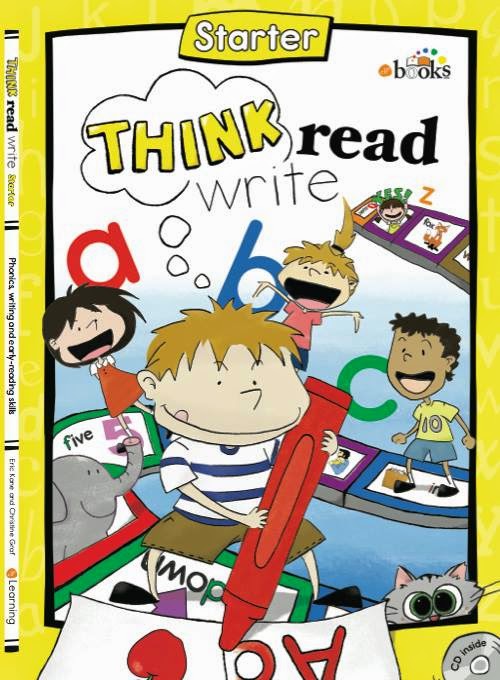
Eric published this amazing book! 
Juan:You have launched books in the area of phonics, which have been very well received. What are the new features you have included in the books? 

Eric: With phonics and other materials I think it's less, "What's new" and more, "What's the Combination." We tried to combine a number of goals in a clear, classic layout that kids will love and teachers will find both effective and easy-to-teach. The main spreads are designed to be very clear while the activity sections are designed to provide opportunities to dig a little deeper into the English language. So far it seems that we have hit a sweet spot with students, parents and teachers giving us a very big thumbs up! 

Juan: Could you share with us how you create and produce your lovely videos? 

Eric: I could, but then I'd have to kill you....

Seriously, there's no rhyme or reason to it.  Many of the videos are based around our curriculum, those are the videos that I have to make for the kids to have exposure to English outside of the classroom.  For the song videos, it's often just a lot of fun!  Sometimes I make the music first.  Sometimes the video section.  It really is all over the place.  I just try my best to use great visuals, great audio and make them fun whenever possible!
Juan: How was the partnership with Mari Nakamura and Patricia Daly Oe in Lily and the Moon? 

Eric: Mari and Patricia and I have a fantastic working relationship.  We each bring different skill sets to the table and each of these sets compliments the other.  For me, the decision to work with and publish Lily and the Moon was made a no-brainer because it meant working with two lovely human beings! 


Juan: Which message would you leave to English teachers of young learners around the world? 

Eric: I suppose I would remind other teachers to focus on being an example of a great communicator. I've found that the more I focus on sincerely trying to connect and identify with students, the more successful they become. 

Juan: Thank you so much for this great interview, Eric!!!


Would you like me to interview anybody you know? 
Do you have any suggestions for this section of the blog? 
Write me and let me know your thoughts! 


Send you all a big hug from Brazil!

Juan


Did you like it? 
Share it! Thank you!

November 17, 2014

Puppeteering interviews with Queenie Tan!


During last Young Learners' Day at TESOL France I had the great pleasure to meet  Queenie Tan and her assistant Jennifer.  Queenie is a well-known author, podcaster, and early childhood educator who lives in Hong Kong and has dedicated herself to educating parents and teachers on how they can become more affective and effective parents and teachers. She has a website and there you can learn more about her books, listen to her podcasts and interviews and much more.


Queenie, Buddy the Frog, and Jennifer in Paris. 
Buddy and I were not interviewed once, but twice in Queenie's show! But how did that happen?

Well, Queenie first interviewed us on how teachers can teach using puppets and then many of the parents that follow her parenting channel liked our interview so much, that they asked us to come to Queenie's parenting channel to talk about how parents can have quality time with their children living imagination and creativity with puppets.


In the first interview Buddy and I shared how teachers can get started in puppeteering and how language development, emotional intelligence, and proactive discipline can be fostered through puppeteering.

Here you can listen to our first interview with Queenie Tan! (audio only)

In the second interview the three of us talked about how parents can use puppets to play with therir children and therefore create memorable moments.

Check here our second interview with Queenie Tan!


Wish you great puppet moments with your children and students!

Which part did you like the most?
Do you have any question that you would like to ask me or Buddy the Frog?


Send you a big puppet-hug directly from Japan!


Juan


Did you like it? Share it!
Thank you!

Check also this video with more puppeteering hints!

September 21, 2014

A rewarding and touching experience in Konya, Turkey


I had the unique privilege of living and learning with a lively group of Algerian teachers when I gave the CTS (Certificate in Teaching Skills) course with SeltAcademy during the last two weeks of August 2014 in Konya, Turkey. 

Check my guest post on SeltAcademy's blog sharing this amazing experience. 


Posing for a group picture one afternoon after we had a session in the garden. 

Celebrating the sense of accomplishment after having completed the course. 


Hugs, 


Juan


Did you like it? Share it!
Thank you!